
Early water sort levels can be solved almost by instinct. Once you reach eight, ten or twelve colors, a few habits make the difference between gliding through and pressing Undo again and again. Here are the ones that matter most, roughly in order of importance. If you're new to the game, start with how to play water sort.
1. Keep one tube empty for as long as you can
An empty tube is your workspace. It lets you lift a color off the top of a tube, look at what's underneath, and come back for it later. The moment every tube has something in it, your options shrink fast.
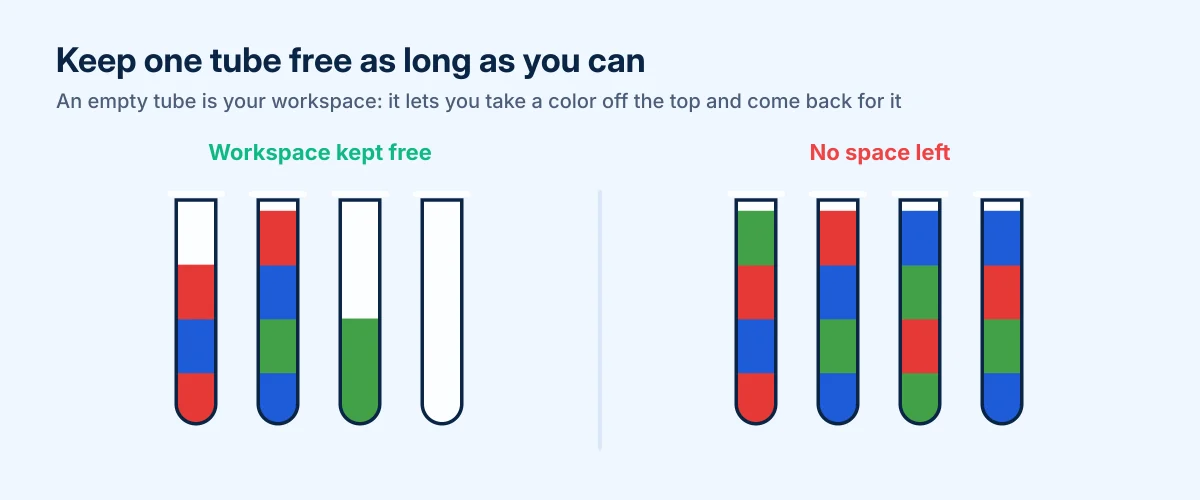
So before you pour into an empty tube, ask: does this move finish a color, or uncover one I need? If not, look for another move.
2. Finish one color at a time
Spreading a color across three tubes feels like progress, but it isn't. Pick a color that's nearly collected, and finish it. A full tube is out of the game, which makes every other decision easier.
3. Read the bottoms, not just the tops
The colors at the bottom of each tube tell you where colors will end up. If red sits at the bottom of a tube, that tube is a natural home for red: pour other colors out of it and red onto it.
4. Don't bury a color you'll need soon
Before you pour, check what you're covering. Pouring blue onto a tube whose top is blue is fine, but if that tube has the last green underneath, you've just made green harder to reach.
5. Pour from the tube with the fewest layers on top of a goal
If two tubes both have yellow on top, pour from the one that will be emptier afterwards. Emptier tubes become free tubes sooner (see tip 1).
6. Use small moves to dig
When a color you need is two layers down, look for a short chain: move the top layer onto a matching color, then the next one, and the color you want comes up. Three small safe moves beat one big risky one.
7. Plan three moves ahead on big boards
On boards with ten or more colors, pause before each move and trace three steps: "if I pour this here, then that comes free, then I can put it there." If the third step goes nowhere, try a different first step.
8. Undo is a planning tool
Undo isn't cheating; it's how you test an idea. Pourfold gives you 5 free undos per level. Use them to explore a line, then step back if it leads nowhere. If you need more, a short video gives you another 5.
9. The extra tube is for real dead ends
Once per level, Pourfold can add one empty tube (after a short video). Save it for positions where nothing can move, not for the first awkward moment. Often a couple of undos solve the problem without it. Our guide to getting unstuck explains when each option makes sense.
Every level has a solution
In Pourfold, each board is checked by a solver before you play it. If a level feels impossible, it isn't: the answer is usually to free a tube earlier, or to finish one color before starting another.